
Friday, January 27, 2012

Wednesday, December 14, 2011

Tuesday, June 7, 2011

Sunday, June 5, 2011

Friday, May 20, 2011

Friday, April 22, 2011
Yellow-rumped Warbler

AKA, Audubon's Warbler.
My first sighting. A flock of 10 were feeding in the grass roadside.
Thursday, January 6, 2011
Buckeye Fruit
This year California Buckeye gained their leaves in May, bloomed in June, shed in August, and were bare by late September as the fruit began to form.
For the very first time, I see squirrels taking the fruit.
 I was under the impression that nothing ate buckeyes -- not deer, not squirrel, not Indians, not nothing...
Here's a squirrel-nibbled buckeye...
 The kids and I were standing in the woods last week when buckeye pieces began raining down on our heads; a squirrel had taken one to the top of a pine.
But the point of this story is that they're sprouting in December!

dropping the husk...

millions underfoot, all sprouting in synchrony this last week of December.

The fruits are the size of golf balls and they litter the ground at the foot of each buckeye tree. If the terrain isn't sharply sloped they remain in place, germinate, and then in the Spring -- when mother buckeye regains her dense foliage -- they wither and die from lack of direct sun.
I'm speaking generally, but.. only buckeye fruit that roll away, downhill, from the mother tree have a chance of survival. Weighty and shaped like a ball, they are perfectly suited for rolling long distances on the bare ground of the California foothills in winter.
So, what of that buckeye tree that stand perched on the top of a hill?
How did the hard, round, heavy fruit ever get up there?
:-)))
For the very first time, I see squirrels taking the fruit.

Here's a squirrel-nibbled buckeye...

But the point of this story is that they're sprouting in December!

dropping the husk...

millions underfoot, all sprouting in synchrony this last week of December.

The fruits are the size of golf balls and they litter the ground at the foot of each buckeye tree. If the terrain isn't sharply sloped they remain in place, germinate, and then in the Spring -- when mother buckeye regains her dense foliage -- they wither and die from lack of direct sun.
I'm speaking generally, but.. only buckeye fruit that roll away, downhill, from the mother tree have a chance of survival. Weighty and shaped like a ball, they are perfectly suited for rolling long distances on the bare ground of the California foothills in winter.
So, what of that buckeye tree that stand perched on the top of a hill?
How did the hard, round, heavy fruit ever get up there?
:-)))
Monday, December 27, 2010
Toyon, Robins, & Waxwings
It's a Robin Invasion!
On every branch of every tree, a robin. Roadside and field are crawling with the buggers. The least puddle finds a robin bathing. Aimless flocks crisscross the sky, looking down on millions of other robins below. The sound of robins drowns out all other bird song.
This happens three or four times a year -- robins suddenly sweeping in and dominating the landscape -- but this is unprecedented.
Worms are their preferred fare, but they also dine on toyon berries. The bushes shimmer and shake when they're infested by the birds.
Yesterday I stepped from the car and a toyon was a riot of robins. Yet something was amiss... there were lookalikes mixed in!
Embiggened this photo to spot 4 robins and 4 fellow-travelling imposters.

A couple of the bandits...

Which explains much:
* the "subtle coloring" Mary & I remarked on distant robins...
* the strange bird we'd seen from the rear on the sidewalk...
Now that my eyes are open, Cedar Waxwings are everywhere.

On every branch of every tree, a robin. Roadside and field are crawling with the buggers. The least puddle finds a robin bathing. Aimless flocks crisscross the sky, looking down on millions of other robins below. The sound of robins drowns out all other bird song.
This happens three or four times a year -- robins suddenly sweeping in and dominating the landscape -- but this is unprecedented.
Worms are their preferred fare, but they also dine on toyon berries. The bushes shimmer and shake when they're infested by the birds.
Yesterday I stepped from the car and a toyon was a riot of robins. Yet something was amiss... there were lookalikes mixed in!
Embiggened this photo to spot 4 robins and 4 fellow-travelling imposters.

A couple of the bandits...

Which explains much:
* the "subtle coloring" Mary & I remarked on distant robins...
* the strange bird we'd seen from the rear on the sidewalk...
Now that my eyes are open, Cedar Waxwings are everywhere.

Sunday, December 26, 2010
Oak-Loving Fungi
After the first rains of November, outlandish growths suddenly appeared on this old oak.
Tentative identification: Chicken of the Woods (Laetiporus gilbertsonii)

I pass this tree every day and the yellow fungus sprouted overnight.

After several weeks it browned and withered.
Fast forward to late December, at the base of the same tree...
Tentative identification: some kind of Chanterelle

Chanterelle favors soil around (or in the nooks and crannies of) oak.

People actually collect and sell this beauty.
Tentative identification: Chicken of the Woods (Laetiporus gilbertsonii)

I pass this tree every day and the yellow fungus sprouted overnight.

After several weeks it browned and withered.
==============================================
Fast forward to late December, at the base of the same tree...
Tentative identification: some kind of Chanterelle

Chanterelle favors soil around (or in the nooks and crannies of) oak.

People actually collect and sell this beauty.
Friday, December 24, 2010
Red-Breasted Sapsucker
A new bird, a Christmas gift.
Across the field, high in a tree, a dim silhouette at dusk with a unrecognized call: "Cheer"
Forget the binoculars!
A pocket digital camera with mega-zoom is a birder's best friend.

If I'd had presence of mind, I would have switched to video and captured its song.
Across the field, high in a tree, a dim silhouette at dusk with a unrecognized call: "Cheer"
Forget the binoculars!
A pocket digital camera with mega-zoom is a birder's best friend.

If I'd had presence of mind, I would have switched to video and captured its song.
Wednesday, December 15, 2010


Friday, December 3, 2010

Wednesday, December 1, 2010

Sunday, November 28, 2010
Coyote Bush
A non-descript shrub I despaired of identifying: unruly, evergreen, common.
Finally, beginning in late September, it began "blooming", tight white hairy tufts.

Small mystery solved.

Finally, beginning in late September, it began "blooming", tight white hairy tufts.

Small mystery solved.

Wednesday, November 17, 2010
Acorns
Mid-November, the birds (and squirrels) are stocking their larder with acorns.
This Scrub Jay is about to bury his acorn in the ground.

The Acorn Woodpecker uses and reuses holes pecked into trees and poles.

Come December this is what all the telephone poles will look like.

There are thieves. Squirrels pry the nuts from telephone poles, and flickers uncover acorns which they did not bury.
Question: what kind of acorns do the different animals favor? Live, Blue, Black, Valley?
A magic sight the other day: a towering Valley Oak and scores of peckers and jays streaming into the dense boughs and leaving with an acorn. It was a river of birds both ways. Then the obvious dawned on me -- they pluck the acorns straight from the branches, and not off the ground. Duh.
This Scrub Jay is about to bury his acorn in the ground.

The Acorn Woodpecker uses and reuses holes pecked into trees and poles.
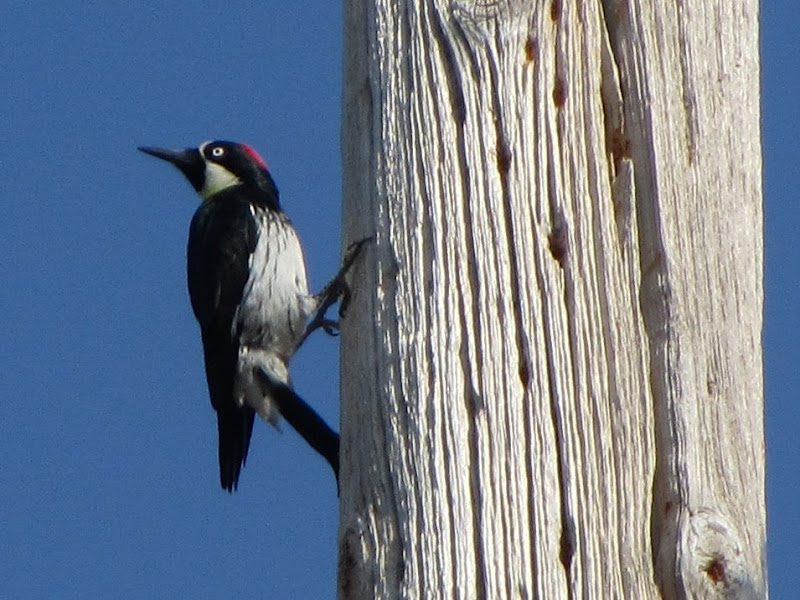
Come December this is what all the telephone poles will look like.

There are thieves. Squirrels pry the nuts from telephone poles, and flickers uncover acorns which they did not bury.
Question: what kind of acorns do the different animals favor? Live, Blue, Black, Valley?
A magic sight the other day: a towering Valley Oak and scores of peckers and jays streaming into the dense boughs and leaving with an acorn. It was a river of birds both ways. Then the obvious dawned on me -- they pluck the acorns straight from the branches, and not off the ground. Duh.
Wednesday, October 27, 2010
Cooper's Hawk
From the bedroom window.

Once I saw a Cooper's skulking near the birdfeeder. He dove into a nearby tree, flushed a goldfinch, and chased it like a rollercoaster through the limbs and branches.
Cooper's resemble Sharp-shinned, but have longer neck and rounded, white-tipped tail.
Both have blood-red eyes!

Once I saw a Cooper's skulking near the birdfeeder. He dove into a nearby tree, flushed a goldfinch, and chased it like a rollercoaster through the limbs and branches.
Cooper's resemble Sharp-shinned, but have longer neck and rounded, white-tipped tail.
Both have blood-red eyes!
Sunday, October 10, 2010
American Kestrel
Kestrels were in this same field last Spring. I noticed their return a few weeks ago.

There's an open barn where small birds nest, a field full of insects, and a telephone pole that makes an ideal perch.
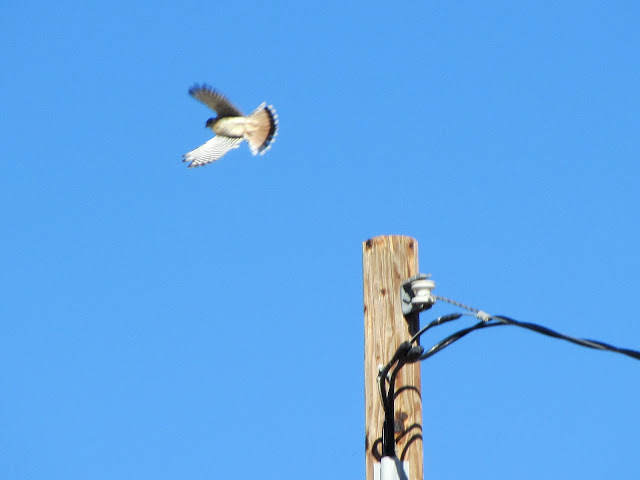
Kestrels are the smallest falcon. They feed on insects and sparrows.

Very handsome.


There's an open barn where small birds nest, a field full of insects, and a telephone pole that makes an ideal perch.

Kestrels are the smallest falcon. They feed on insects and sparrows.

Very handsome.

Tuesday, October 5, 2010

Friday, October 1, 2010
California Harvester Ant
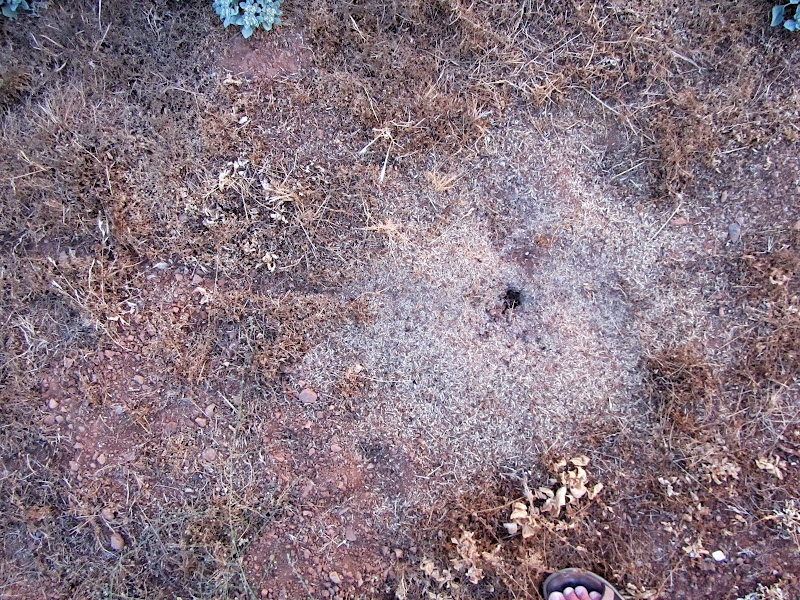
A typical harvester nest. This photograph was taken in July.

The entrance is a rude crack in the ground surrounded by a halo of trash: shells & husks mainly, some tiny pebbles brought up from below, and an occasional insect corpse.
When they arrive, ants take their seed straight down the hole (presumable to storage chambers). Sometime later detritus is brought back up. In between, what happens?

The trash seems to reflect what's currently in seed within 100 feet of the nest. If that's the case, their harvest doesn't stay in storage long. They do make mistakes and gather the inedible.
Below is the same nest yesterday (~2 months later).

The mix has largely changed.

The white parachute seeds appeared only yesterday. I'll look around a see where they come from.
One curiosity is that harvesters feed on a single plant at a time; they don't scatter helter-skelter, but travel bee-line from the nest.
Here's a path running due left from the hole. Up close it looks like they'd worn a gutter in the ground with a billion little footsteps.

Below groundlevel, it looks so: an actual mold of a harvester nest.

The scientist poured molten copper down the hole of Florida harvesters in order to capture the architecture.

The entrance is a rude crack in the ground surrounded by a halo of trash: shells & husks mainly, some tiny pebbles brought up from below, and an occasional insect corpse.
When they arrive, ants take their seed straight down the hole (presumable to storage chambers). Sometime later detritus is brought back up. In between, what happens?

The trash seems to reflect what's currently in seed within 100 feet of the nest. If that's the case, their harvest doesn't stay in storage long. They do make mistakes and gather the inedible.
Below is the same nest yesterday (~2 months later).

The mix has largely changed.

The white parachute seeds appeared only yesterday. I'll look around a see where they come from.
One curiosity is that harvesters feed on a single plant at a time; they don't scatter helter-skelter, but travel bee-line from the nest.
Here's a path running due left from the hole. Up close it looks like they'd worn a gutter in the ground with a billion little footsteps.
Below groundlevel, it looks so: an actual mold of a harvester nest.

The scientist poured molten copper down the hole of Florida harvesters in order to capture the architecture.
Tuesday, September 28, 2010
Narrow-Leaved Milkweed
Now at the end of September...

...the seedpods are bursting open.

For comparison, the same plant one month ago...

...in flower, even as some pods were forming.
It began like this: back at the end of July, flowers were first opening...

...no idea what the outlandish orange mites were about.

...the seedpods are bursting open.

For comparison, the same plant one month ago...

...in flower, even as some pods were forming.
It began like this: back at the end of July, flowers were first opening...

...no idea what the outlandish orange mites were about.
Subscribe to:
Posts (Atom)