Wednesday, October 27, 2010

Cooper's Hawk

From the bedroom window.


Once I saw a Cooper's skulking near the birdfeeder.  He dove into a nearby tree, flushed a goldfinch, and chased it like a rollercoaster through the limbs and branches.

Cooper's resemble Sharp-shinned, but have longer neck and rounded, white-tipped tail.
Both have blood-red eyes!

Sunday, October 10, 2010

American Kestrel

Kestrels were in this same field last Spring. I noticed their return a few weeks ago.


There's an open barn where small birds nest, a field full of insects, and a telephone pole that makes an ideal perch.


Kestrels are the smallest falcon.  They feed on insects and sparrows.


Very handsome.

Tuesday, October 5, 2010

Pacific Gopher Snake


Struck by a car.  About 18" long.

Friday, October 1, 2010

California Harvester Ant

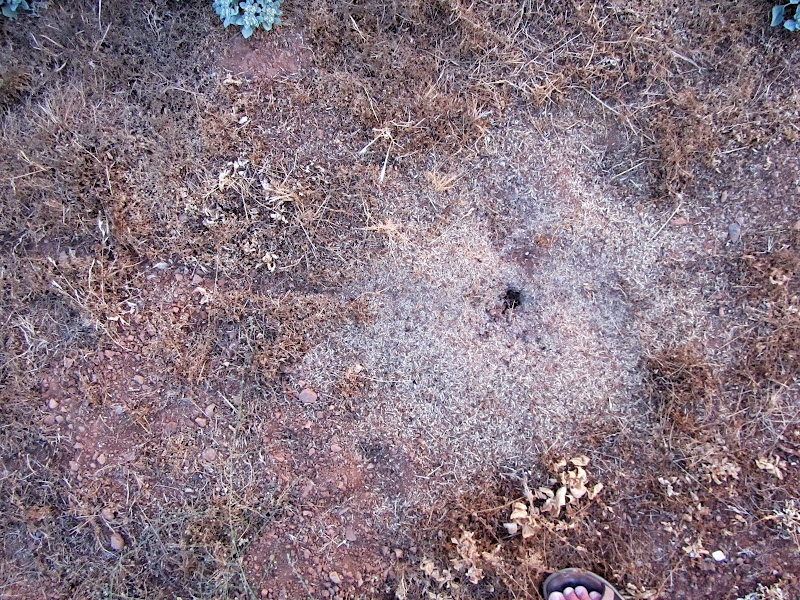
A typical harvester nest.  This photograph was taken in July.


The entrance is a rude crack in the ground surrounded by a halo of trash: shells & husks mainly, some tiny pebbles brought up from below, and an occasional insect corpse.

When they arrive, ants take their seed straight down the hole (presumable to storage chambers).  Sometime later detritus is brought back up.  In between, what happens? 


The trash seems to reflect what's currently in seed within 100 feet of the nest.  If that's the case, their harvest doesn't stay in storage long.  They do make mistakes and gather the inedible.


Below is the same nest yesterday (~2 months later).


The mix has largely changed.


The white parachute seeds appeared only yesterday.  I'll look around a see where they come from.

One curiosity is that harvesters feed on a single plant at a time; they don't scatter helter-skelter, but travel bee-line from the nest.

Here's a path running due left from the hole.  Up close it looks like they'd worn a gutter in the ground with a billion little footsteps.


Below groundlevel, it looks so:  an actual mold of a harvester nest.


The scientist poured molten copper down the hole of Florida harvesters in order to capture the architecture.

Tuesday, September 28, 2010

Narrow-Leaved Milkweed

Now at the end of September...


...the seedpods are bursting open.


For comparison, the same plant one month ago...


...in flower, even as some pods were forming.

It began like this: back at the end of July, flowers were first opening...


...no idea what the outlandish orange mites were about.

Thursday, September 23, 2010

Tobacco Hornworm

Something caught my eye.


The plant is called "Indian Tobacco"; it's in the same genus, Nicotiana, as regular smoking tobacco.

The caterpillar becomes a very large (5" wingspan) moth called Carolina Sphinx that flies at dawn and dusk and feeds on the flowers of the same family of plants, the Nightshade.  And that's also where it lays its eggs.

If the caterpillar survives predators it will pupate underground for the winter, emerge in the Spring, and the cycle begins again.


The caterpillar's head is at the bottom of the photo.

Wednesday, September 22, 2010

Great Egret


The seasonal pond is no more than a puddle, but he tried to fish...


...until I disturbed him. Some species of birds do not like to be watched by humans, even from a safe distance.

Note the green line under the eye. And massive beak.